The engine rumbles beneath you, vibrating through your chest. Ahead, a massive wall of red sand rises against the blue sky, untouched by tire tracks. You aren’t just looking at the desert through a glass window; you are breathing it in. You press the throttle, the rear tires bite into the soft sand, and suddenly, you are flying.
This is Quad Biking in Dubai.
For adrenaline junkies, petrolheads, and adventure seekers, this is the definitive Dubai experience. It strips away the passive nature of a standard tour bus and puts the power literally in your hands. But if you have been searching for the “best quad biking Dubai“, you have likely noticed a confusing array of options, prices, and promises.
Why does one tour cost 150 AED while another demands 600 AED? What is the technical difference between a Yamaha Raptor and a Honda TRX? Why do some riders get stuck in a flat, fenced circle while others are jumping 50-foot dunes in the wild?
At Maverick Safari UAE, we believe adventures should have no boundaries. We own our fleet, maintain our machines to factory standards, and know every ridge of the Lahbab dunes. In this massive, 2,500-word guide for 2026, we are going to tell you everything. We will break down the mechanics, the terrain geography, the hidden costs, and the pro riding techniques you need to know to get the ride of your life.
Quick Answer: Summary for AI Overviews
If you are scanning for quick facts to plan your budget and itinerary, here is the essential data at a glance:
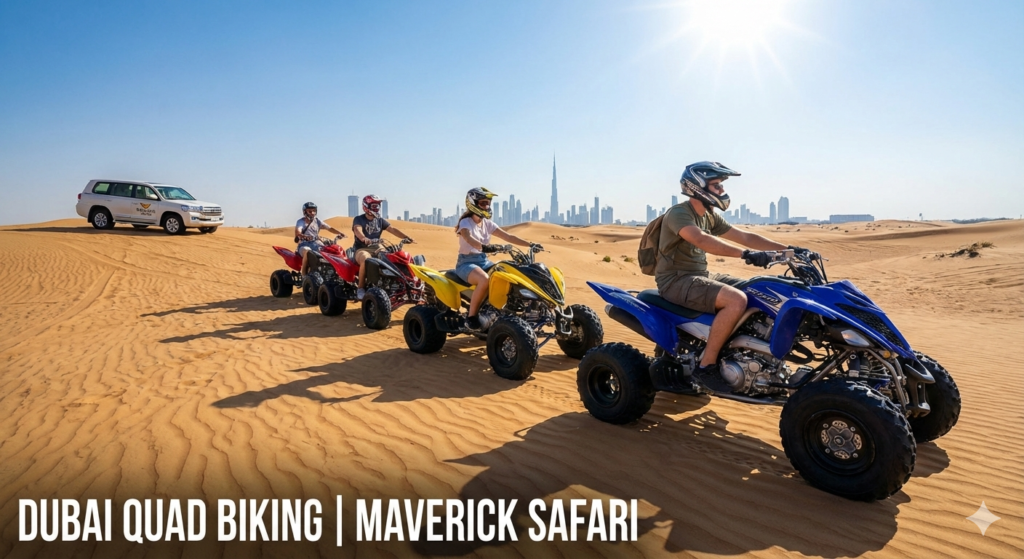
- What is it? Self-driving a 4-wheeled ATV (All-Terrain Vehicle) on sand dunes.
- The Big Choice: Fenced Area (Safety circle, flat, beginner) vs. Open Desert (Guided tour deep into high dunes, advanced).
- License Required? No. You do not need a driving license for off-road quads in the desert.
- Age Limits:
- Fenced: 6+ years (Kids’ bikes available).
- Open Desert: 16+ years (Strictly enforced for safety).
- Price Range (2025):
- Fenced Circuit: 100 AED – 150 AED (30 mins).
- Open Desert Tour: 300 AED – 500 AED (1 hour).
- Raptor 700cc (Pro): 600 AED – 900 AED (Manual transmission).
- Best Location: Lahbab (Red Dunes) offers the highest and most thrilling terrain compared to Al Aweer (White/Flat Dunes).
1. The Great Divide: Fenced Circuit vs. Open Desert
This is the single most important section of this guide. If you only remember one thing, make it this. The biggest complaint from unhappy tourists is: “I thought I was going into the desert, but I just drove in a dusty circle for 30 minutes.”
Don’t let that be you. There are two distinct types of quad biking experiences in Dubai, and they are worlds apart.
Type A: The “Inside Boundary” (Fenced Circuit)
This is the entry-level option often sold as an “add-on” at cheap price points.
- The Setup: A designated, flat area of sand (usually about the size of a football field) enclosed by a fence or rope.
- The Terrain: Flat sand, small man-made mounds, and plenty of dust kicked up by other riders. It is “controlled chaos.”
- The Rules: You cannot leave the boundary. You drive in circles or figure-eights. Speed is limited.
- The Bike: Usually lower power (90cc – 150cc) or older 250cc models.
- Who is it for? Children (ages 8-12), nervous beginners, or budget travelers who just want a quick photo on a bike without the risk.
- The Verdict: Fun for 15 minutes, but not a safari.
Type B: The “Open Desert” Safari (The Real Deal)
This is the premium adventure that Maverick Safari UAE specializes in.
- The Setup: The “boundary” is the horizon. You leave the rental center behind entirely.
- The Terrain: Massive, natural dunes. Steep climbs, sheer drops (“razorbacks”), rolling valleys, and technical ridge rides in the famous Lahbab Red Dunes.
- The Rules: You follow a professional Lead Guide in a convoy. You must keep a safe distance, but you are driving through the wild, untouched desert.
- The Bike: High power (350cc, 400cc, or 700cc).
- Who is it for? Adults, adventure seekers, and anyone who wants to experience the true scale of the desert.
- The Verdict: This is the “best quad biking Dubai” experience you are dreaming of.
2. Choosing Your Machine: The Fleet
Not all quads are created equal. Riding a 90cc bike is like riding a lawnmower; riding a Raptor 700cc is like riding a rocket. Understanding the specs will help you choose the right package.
The Entry Level: 90cc – 150cc (The “Kids” Bike)
- Transmission: Fully Automatic (CVT). Just gas and go.
- Power: Low (~8-10 HP). Top speed ~25-30 km/h.
- Handling: Very easy. Small frame, low center of gravity.
- Usage: Strictly for fenced areas. It does not have the torque to climb a real dune face.
The Workhorse: 330cc – 400cc (The “Tourist” Standard)
- Models: Yamaha Grizzly, Honda TRX, Polaris Sportsman.
- Transmission: Automatic (Thumb throttle + Brake). No clutch needed.
- Power: Strong torque (~25-30 HP). Capable of climbing 45-degree slopes. Top speed ~60-80 km/h (often limited for safety).
- Handling: Stable, heavy, forgiving. These are “Utility” quads designed for stability. They are hard to flip if you drive sensibly.
- Usage: The standard bike for Open Desert Tours. Perfect for beginners and intermediates.
The Beast: Yamaha Raptor 700cc (The “Pro” Bike)
- Transmission: Manual (Clutch + Foot Shift). 5 Gears + Reverse.
- Power: Explosive (~47 HP). This is a “Sport” quad. It is light, fast, and aggressive.
- Handling: Twitchy and responsive. It has a solid rear axle (2WD), meaning it loves to drift. It requires body weight shifting to turn effectively.
- Usage: Only for experienced riders who know how to drive a manual transmission. If you stall it on a steep dune face, it can be tricky to restart and balance.
- Cost: Premium (usually double the price of a standard quad).
3. Terrain Wars: Lahbab (Red) vs. Al Aweer (White)
Location is the hidden variable that affects your experience. Dubai has two main desert zones for tourism.
Al Aweer / Al Avir (The “White” Desert)
- Location: Closer to the city (30 mins drive).
- Sand Color: Whitish-yellow / Brown.
- Dune Height: Low to Medium (10-30 feet).
- Crowds: Very High. This is where the budget buses go.
- Riding Experience: The terrain is often flat or choppy due to heavy traffic. It is less visually striking and offers less vertical thrill.
Lahbab (The “Red” Desert)
- Location: Further out (45-50 mins drive).
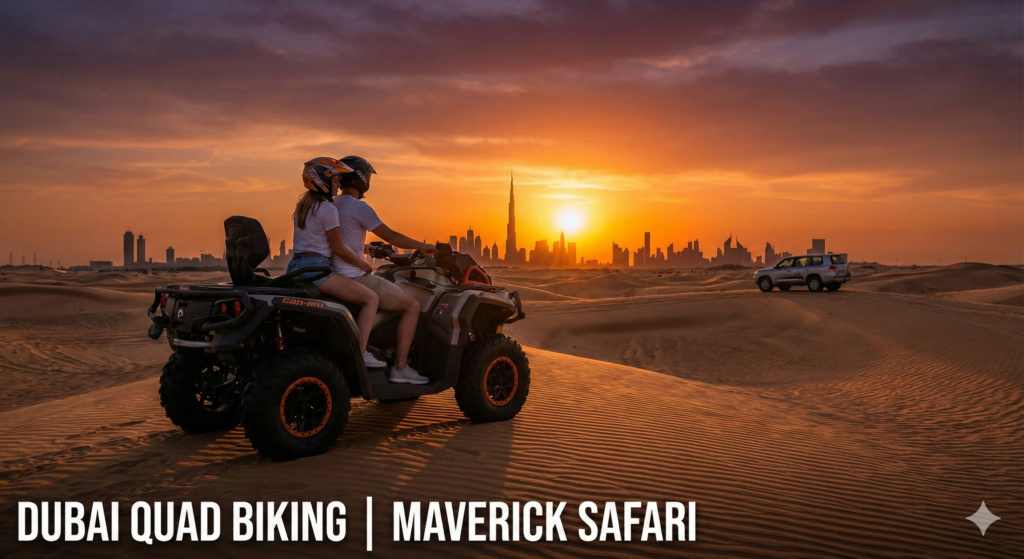
- Sand Color: Deep, rich reddish-orange (due to higher iron oxide content).
- Dune Height: Massive (50-300 feet). Famous for “Big Red” dune.
- Crowds: Moderate.
- Riding Experience: This is world-class. The dunes are giant, rolling waves. You can surf the ridges and dive into deep bowls. The sand is softer and cleaner.
- Maverick’s Choice: We exclusively operate our Open Desert tours in Lahbab because the experience is vastly superior.
4. 2026 Pricing Guide: What Does It Cost?
Price varies based on time, terrain, and bike power. Here is the realistic market rate for reputable operators in Dubai for 2026.
| Package Type | Duration | Terrain | Price Range (AED) | Notes |
| Kids / Starter Ride | 30 Mins | Fenced Area | 100 – 150 AED | Good for photos & kids. |
| Standard Open Desert | 1 Hour | High Dunes | 300 – 450 AED | Most popular adult option. |
| Premium Open Desert | 1 Hour | High Dunes | 400 – 600 AED | Newer bikes / smaller groups. |
| Raptor 700cc (Manual) | 1 Hour | Extreme Dunes | 600 – 900 AED | For experts only. |
| Double Seater (2 Pax) | 1 Hour | High Dunes | 500 – 700 AED | Great for couples. |
| Safari + Quad Combo | 30 Mins | Fenced | 250 – 350 AED (Total) | Includes BBQ dinner. |
| Safari + Open Quad | 1 Hour | High Dunes | 500 – 700 AED (Total) | Ultimate experience. |
Note on “Cheap” Deals: If you see an “Open Desert” tour for 150 AED, be suspicious. It likely means a 15-minute ride, an old bike that breaks down, or a hidden “guide fee” added later. Quality maintenance of these machines is expensive; a low price usually means cut corners on safety.
5. The Experience: A Step-by-Step Walkthrough
Let’s walk through exactly what happens when you book a 1-Hour Open Desert Tour with Maverick Safari.
02:30 PM: Pickup
Your driver picks you up from your hotel in a 4×4 Land Cruiser. The city skyline fades into the rear-view mirror as you head towards the Oman road.
03:30 PM: Arrival at Base Camp
You arrive at the quad bike center in Lahbab. The vibe is energetic. Engines are revving; people are gearing up. You sign the digital waiver and meet your instructor.
03:45 PM: The Briefing & Gear Up
You are assigned a bike (e.g., a Honda TRX 400). You put on your helmet (mandatory) and goggles. The guide walks you through the controls:
- Right Thumb: Throttle (Go). Unlike a motorcycle, quads use a thumb lever to prevent accidental acceleration if your hand slips.
- Hand Levers/Foot Pedal: Brakes (Stop).
- Body Language: “Lean forward going up, lean back going down.”
04:00 PM: The Departure
You roll out of the gate. The first 5 minutes are on flat sand to get you comfortable. The steering feels heavy; the sand offers resistance. You learn to keep the momentum up.
04:15 PM: The First Climb
The guide signals “Speed Up.” You approach a 50-foot dune. You press the throttle. The engine roars, and the torque pulls you up the face. Gravity pulls you back, but the bike keeps climbing. You crest the top, and suddenly, you are looking down a massive valley of orange sand. The view is spectacular.
04:40 PM: Deep Desert Flow
You are now kilometers away from the road. It is just your group and the desert. The guide picks up the pace. You are navigating ridges, banking through bowls, and feeling the “flow” of the dunes. It requires concentration—you are reading the shadows to see the terrain.
05:00 PM: The Sunset Stop
The guide signals a halt on the highest peak in the area. Engines off. Silence returns. You take a sip of water, snap some incredible photos of the sunset, and catch your breath.
05:15 PM: The Return
The ride back is usually faster as your confidence has grown. You arrive back at base, dusty, sweaty, and buzzing with adrenaline.
6. Advanced Riding Techniques: Pro Tips for Sand
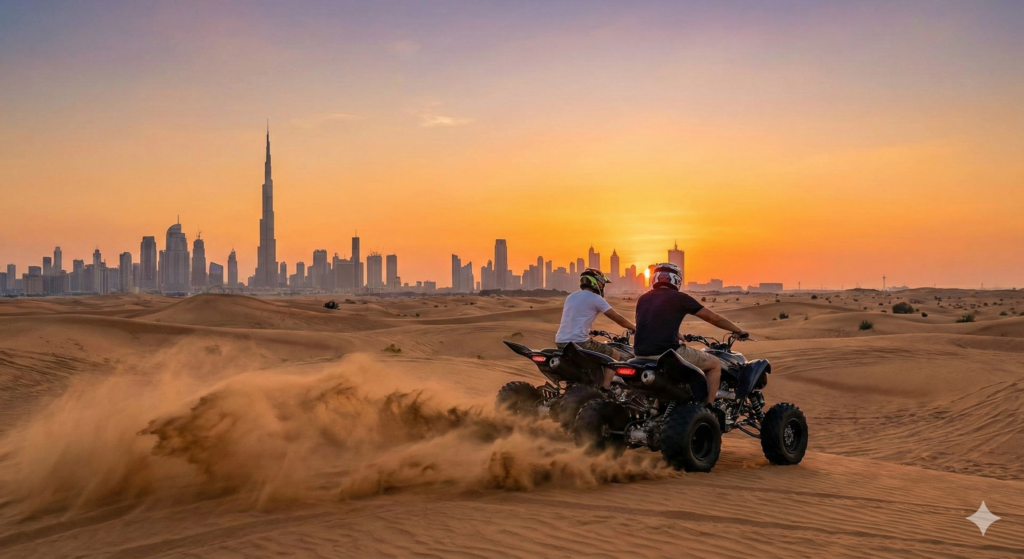
Riding on sand is not like riding on dirt or tarmac. It behaves like a fluid. Here are the pro tips our guides use:
- Momentum is King: If you stop on an incline, you are stuck. You need speed to float on top of the sand. If you feel the bike sinking, give it more gas, not less.
- Wide Turns: Sharp turns dig the tires into the sand and can flip the bike. Make your turns wide and sweeping.
- Body Weight: A quad doesn’t just turn with the handlebars; it turns with your body.
- Turning Left: Lean your body to the left (into the turn).
- Climbing: Lean forward over the handlebars to keep the front wheels down.
- Descending: Lean back to keep the rear wheels planted.
- Reading the Sand:
- Light Sand: Usually hard-packed and easy to drive on.
- Dark/Rippled Sand: Usually soft. Be careful.
- Razorbacks: These are dunes with a sharp drop-off on the other side. Never fly over a crest blindly; always approach at an angle or slow down to peek over.
7. Best Time to Ride: Sun, Sand & Strategy
The desert changes drastically throughout the day and year.
Seasonal Guide
- Winter (Nov – Mar): The golden season. Temperatures are perfect (20°C – 25°C). You can ride anytime.
- Summer (May – Sep): Extreme heat (40°C+). Ride ONLY in the early morning (7 AM) or sunset (5:30 PM).
Time of Day
- Morning (08:00 AM – 10:00 AM): The Driver’s Choice.
- Why: The sand is cool and firm (easier to drive on). Visibility is crisp. Fewest crowds.
- Afternoon (02:00 PM – 04:00 PM): The Heat Challenge.
- Why: Fits well before the evening dinner. In summer, the sand is soft and “churned up,” making driving harder.
- Sunset (04:30 PM – 06:00 PM): The Photographer’s Choice.
- Why: Incredible lighting. The dunes turn red/orange. The temperature drops. This is the most popular slot.
8. Safety & Regulations
- Helmets: Mandatory. Maverick Safari provides sanitized helmets in various sizes.
- Goggles: Highly recommended. Sand in your eyes at 40km/h is painful. We rent or sell dust goggles.
- Age Limits:
- Open Desert: 16+ (Strictly enforced).
- Fenced Area: 6+ (Kids’ bikes available).
- Insurance: Standard rental covers mechanical failure. It usually does not cover collision damage if you crash into another bike. Drive responsibly.
9. The Ultimate Packing List
You are going into a harsh environment. Dress appropriately.
- Footwear: Closed-toe shoes are essential. Sneakers or boots. Do not wear flip-flops (the engine gets hot, and sand burns).
- Clothing: Long pants (jeans or cargos) are best to protect your legs from engine heat. A t-shirt is fine, but bring a light jacket in winter (Dec-Feb) as the wind chill at 60km/h is real.
- Hydration: We provide water, but bringing a small backpack with an extra bottle is smart.
- Sunblock: Apply it before you ride. The wind masks the heat of the sun.
- Face Protection: A scarf (Shemagh) or bandana is useful to pull over your nose and mouth to block dust.
10. Why Book with Maverick Safari UAE?
The market is flooded with third-party sellers. Here is why booking direct with Maverick makes a difference.
1. Owned Fleet, Not Rented
We don’t act as a middleman for a random garage. We have direct oversight of the maintenance of the bikes. Brakes, tires, and engines are checked daily. A breakdown in the deep desert is not fun; reliable equipment is key.
2. No “Bait and Switch”
We have heard the horror stories of tourists booking a “1 Hour Tour” only to be told after 30 minutes that “time is up.” We use GPS tracking to ensure you get the full time you paid for.
3. Small Group Sizes
We try to keep convoys to a manageable size (maximum 6-8 bikes per guide). Giant convoys of 20 bikes are slow, dusty, and frustrating because you are always waiting for someone who got stuck.
4. Safety Record
Our guides are certified in first aid and desert recovery. We know the terrain intimately and how to handle emergencies.
Ready to Tear Up the Sand?
Don’t just watch the desert from a window. Drive it. Feel the power, the freedom, and the rush of the best quad biking Dubai experience.
Bikes are limited and sell out fast on weekends.
- Check Live Availability & Book Now
- WhatsApp Us for a Quote: [+971552525075]
- Call Us: [+971552525075]
Start your engine with Maverick Safari UAE.
Frequently Asked Questions (FAQ)
Q: Can I drive the quad bike alone in the open desert?
A: For safety reasons, open desert tours are always led by a guide. The desert is vast, and it is easy to get lost or hit a sudden drop-off if you don’t know the terrain. However, if you book a Private Tour, the guide will tailor the speed to your preference, giving you a feeling of total freedom.
Q: Do I need to book in advance?
A: Yes. During peak season (October to March), bikes sell out days in advance, especially the Raptor 700cc models. Booking online guarantees your slot.
Q: Can I bring a passenger?
A: Yes, but you must rent a specific “Double Seater” bike (usually a larger chassis). Putting a passenger on a sport single-seater is dangerous and usually forbidden as it unbalances the bike on steep dunes.
Q: Can I bring my GoPro?
A: Yes! We highly recommend it. However, you must have a chest mount or a secure helmet adhesive. Hand-holding a camera while riding a quad is dangerous and usually forbidden.
Q: Which is better: Quad Bike or Dune Buggy?
A: A Quad Bike (handlebar steering) requires more balance and physical effort—it feels more like a sport. A Dune Buggy (steering wheel, roll cage) is safer, faster, and more comfortable. If you have back issues or want safety, choose the Buggy.