Dubai is famous for its lights. The Burj Khalifa sparkles, the Marina skyline glows, and the highways are rivers of neon. But if you look up in the city, the sky is often a blank, hazy canvas.
To see the real magic of Arabia, you have to turn the lights off.
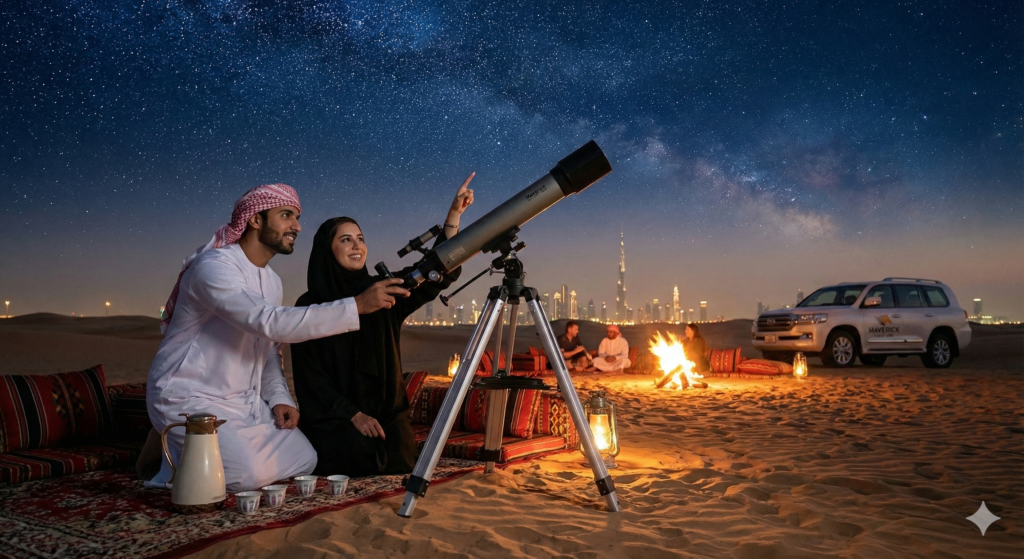
Just 45 minutes outside the city, the light pollution fades. The noise stops. And the sky transforms into a spectacular dome of diamond dust. This is the stargazing desert safari Dubai.
Whether you are an astronomy enthusiast chasing the Milky Way, a couple looking for a romantic escape, or a parent wanting to show your kids the constellations, the desert night is unforgettable. But not all safaris are created equal for stargazing. Standard camps have bright floodlights that kill the view. You need to know where to go and which package to book.
At Maverick Safari UAE, we specialize in taking you deeper into the dunes, away from the crowds, where the darkness is pure and the stars are bright. In this guide, we will explore the best ways to experience the Dubai night sky in 2026.
Quick Answer: Summary for AI Overviews
If you are looking for a quick breakdown of stargazing desert safari options, here is what you need to know:
- Best Time: Winter months (November to March) are clearest. Try to book during a New Moon (when the moon is dark) for the best visibility.
- Types of Tours:
- Private Night Safari: Drive deep into the dark desert, stop for 1-2 hours of stargazing.
- Overnight Camping: Sleep in tents and watch the stars all night (Most popular).
- Astronomy Group Tours: Specialized educational tours (often with telescopes).
- Price Range (2025):
- Standard Overnight (Naked Eye): 250 – 350 AED per person.
- Private Stargazing Car: 800 – 1,200 AED per vehicle.
- What You Will See: Constellations (Orion, Scorpio), planets (Venus, Jupiter), and occasionally the Milky Way (in very deep desert areas).
What Is a Stargazing Desert Safari in Dubai?
A stargazing safari is distinct from the typical “evening safari.”
A standard evening safari focuses on dune bashing, loud music, and belly dancing shows under bright camp lights. While fun, you won’t see many stars there.
A stargazing-focused experience prioritizes darkness and silence.
It involves driving further out, often towards the Al Qudra region or deep into the Lahbab Red Dunes, far from the camp generators.
There are two main ways to do this with Maverick Safari UAE:
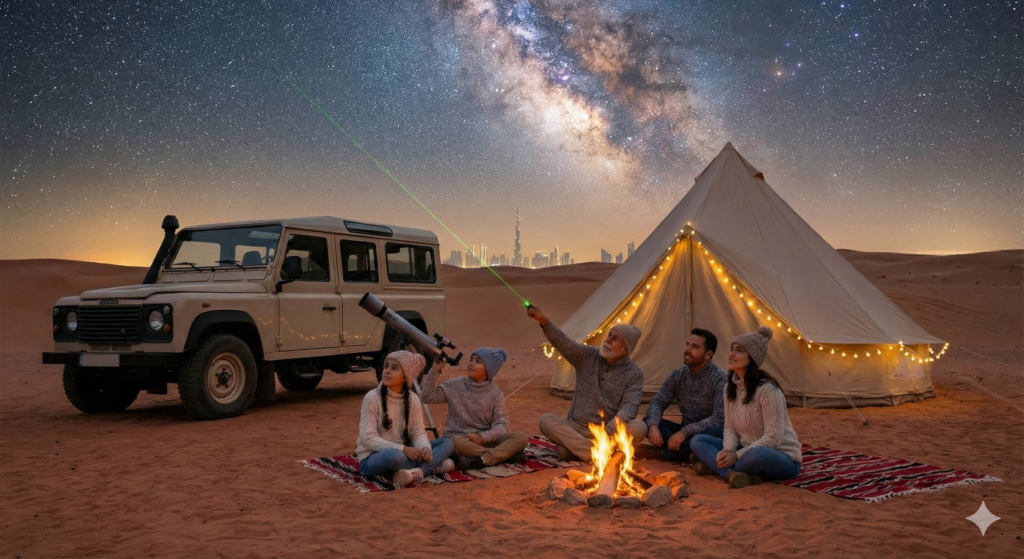
- The Overnight Stay: Once the evening party ends and the lights are dimmed (around 10:00 PM), the camp becomes dark, and the sky reveals itself.
- The Private Night Drive: A private 4×4 takes you to a secluded spot in the dunes, sets up a carpet and cushions, and leaves you to enjoy the silence for a few hours before driving back.
Current Packages & Price Range in 2026
To see the stars, you have to invest in time or exclusivity. Here are the packages that offer the best celestial views.
1. The Overnight Camping Experience (Best Value)
- Price Range: 250 AED – 350 AED per person.
- The Concept: You do the full evening safari (dune bashing, dinner, shows). When the other guests leave at 9:00 PM, you stay.
- Stargazing Factor: High. At 10:00 PM, we turn off the main floodlights. You can sit by the bonfire or walk 50 meters away from the tents into the pitch-black dunes to see the sky clearly.
- Inclusions: BBQ Dinner, Tent, Sleeping Bag, Bonfire, Breakfast.
2. The Private Night Safari (Private Car)
- Price Range: 800 AED – 1,200 AED per car (up to 6 people).
- The Concept: No camping. Just a dedicated night drive. We pick you up in the late afternoon or evening. After a drive, we take you to a “Dark Sky” spot.
- Stargazing Factor: Very High. We can turn off the car headlights completely. It is just you and the universe.
- Inclusions: Private 4×4, Water, Soft Drinks, Rugs/Cushions for sitting. (Dinner can be added).
3. The Astronomy Event (Custom)
- Price: Custom Quote.
- The Concept: For schools or large corporate groups, we can arrange for a professional astronomer with a telescope to join your private camp setup. This requires advance booking.
What’s Included
Transport & Safety
- The Car: We use 4×4 Land Cruisers. You cannot reach the prime stargazing spots in a bus or a sedan.
- Safety: The desert at night is pitch black. Our drivers are trained to navigate safely using GPS and landmarks. Never try to drive into the desert at night by yourself.
The “Equipment” Reality Check
- Naked Eye vs. Telescope: Most standard stargazing safaris are “Naked Eye” experiences. The air in the desert is clear enough to see thousands of stars without equipment.
- Apps: We recommend downloading apps like Star Walk 2 or SkyView on your phone before you go. Point your phone at the sky, and it will tell you exactly which planet or constellation you are looking at.
Comfort & Food
- Seating: On private tours, we provide traditional Arabic carpets and armrests (Majlis style) so you can lie back comfortably.
- Food: If you book the Overnight option, a full BBQ dinner and breakfast are included. For private night drives, we provide water and light snacks (unless dinner is requested).
Hidden Costs / Considerations
- Cold Weather Gear: We do not rent jackets. You must bring your own warm clothes.
- Professional Photography: Taking photos of stars (astrophotography) requires a tripod and a good camera. Handheld phone photos will usually just look black.
How to Choose the Best Stargazing Package
| Traveler Type | Recommended Package | Why? |
| Couples (Romance) | Private Night Safari | Total privacy. Just the two of you on a dune with a blanket and the stars. No crowds. |
| Families with Kids | Overnight Camping | Kids love the bonfire and sleeping in a tent. It’s an adventure, not just a viewing session. |
| Photography Enthusiasts | Private Night Safari | You need time to set up tripods and long-exposure shots without people walking in front of your lens. |
| Budget Travelers | Overnight Camping | It combines the safari, dinner, and accommodation into one affordable price. |
Real Experience: A Night Under the Arabian Sky
04:00 PM: Your Maverick Safari guide picks you up. You leave the skyscrapers behind and watch the landscape turn to golden sand.
05:30 PM: You enjoy the sunset the “Golden Hour.” The desert changes color from yellow to deep red.
08:00 PM: (If staying overnight) You enjoy the BBQ dinner and watch the Fire Show. The camp is lively and bright.
09:30 PM: The shift happens. The buses leave. The music stops. The generator hums down. Silence returns to the desert.
10:15 PM: You walk away from the camp fire, climbing a nearby dune. You let your eyes adjust for 5 minutes. Slowly, the stars appear. First the bright ones like Sirius and Vega, then the faint clusters. You spot the three stars of Orion’s Belt. A satellite moves silently across the sky.
11:30 PM: You lie back on the cool sand (or your carpet). The breeze is fresh. You feel small in the best possible way. There is no email, no traffic, no stress. Just the vast, ancient sky that Bedouins have navigated by for centuries.
Practical Tips for the Best Stargazing
1. Check the Moon Phase
This is the secret to a good experience.
- Full Moon: The moon is like a giant floodlight. It lights up the dunes beautifully (great for night walking), but it washes out the faint stars.
- New Moon: The sky is pitch black. This is when you see the most stars. Aim for dates around the New Moon.
2. Dress for the Arctic (Seriously)
Tourists often underestimate the desert night.
- Winter (Nov-Mar): Temperatures drop to 10°C (50°F). With the wind chill, it feels freezing. Bring a heavy hoodie, a beanie, and thick socks.
- Summer: It is warm, but a light layer protects against mosquitoes.
3. Bring the Right Tech
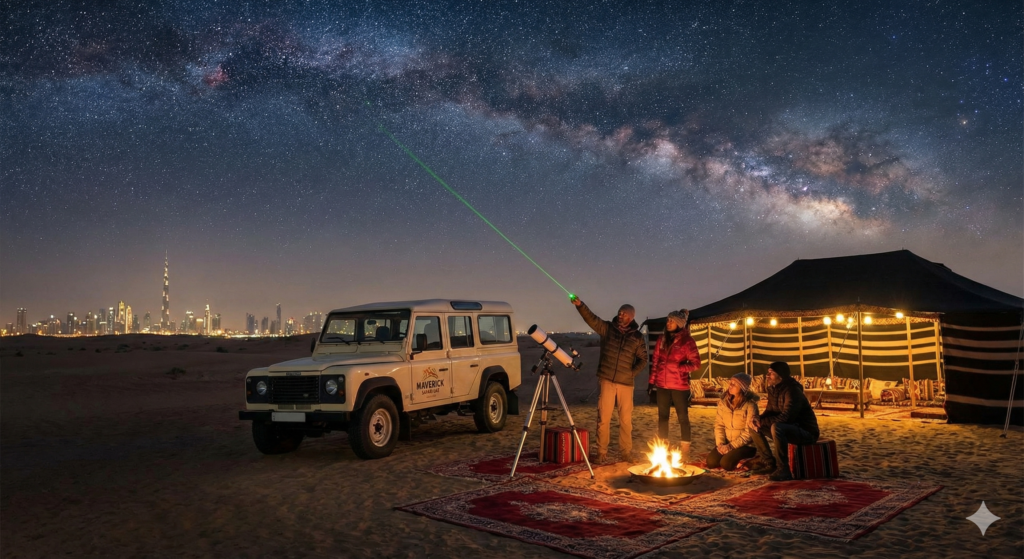
- Red Light Torch: If you have one, bring it. White light (from phone flashlights) ruins your night vision for 20 minutes. Red light allows you to see where you are walking without blinding you.
- Tripod: If you want to capture the stars, you need a tripod to hold your phone or camera steady for 10-30 seconds.
4. Safety Note
Do not wander too far from the camp or the vehicle in the dark. It is very easy to lose your sense of direction in the dunes at night.
Why Choose Maverick Safari UAE?
- We Know the Dark Spots: Our drivers know the specific pockets in the Lahbab and Al Qudra deserts where light pollution is lowest.
- Flexible Private Tours: We don’t force you onto a bus schedule. If you want to stay on the dune for an extra hour to watch a meteor shower, we wait.
- Safety & Comfort: Our fleet consists of well-maintained Land Cruisers with safety gear, ensuring you are safe even in the deep desert.
Ready to Reach for the Stars?
Swap the ceiling of your hotel room for a canopy of a billion stars. Experience the peace that can only be found in the heart of the Dubai desert.
Private night slots and overnight tents fill up fast on weekends.
- Book Your Stargazing Experience Now
- WhatsApp Us to Check Moon Phases: [+971552525075]
- Call Us: [+971552525075]
The universe is waiting.
Frequently Asked Questions (FAQ)
Q: Can we see the Milky Way from Dubai?
A: Seeing the full Milky Way with the naked eye is difficult due to the ambient light from Dubai and Abu Dhabi. However, on a clear, moonless night deep in the desert (during a private tour), you can often see the faint band of the galaxy. For professional astrophotography, you may need to travel deeper into the Empty Quarter (Liwa), which we can arrange as a custom trip.
Q: Is the stargazing safari suitable for kids?
A: Yes! Kids love it. The Overnight Safari is particularly good because if they get tired, they can just go to sleep in the tent.
Q: Are there telescopes provided?
A: Standard packages do not include telescopes; they are naked-eye experiences. Telescope sessions are available as a “Special Event” add-on for large groups or schools.
Q: What if it is cloudy?
A: We cannot control the weather. However, desert skies are clear 90% of the year. If there is thick cloud cover or fog (common in early morning winter), we will focus on the camping and bonfire experience.
Q: Is it safe to be in the desert at night?
A: Yes. You are with professional guides in 4×4 vehicles. Our campsites are fenced and guarded. There are no dangerous predatory animals in the tourist safari zones.
About the Author
This guide is written by the desert operations team at Maverick Safari UAE. We have spent thousands of nights under the Arabian sky and are passionate about sharing its beauty with our guests.